
Back to all work
PRODUCT DESIGN • SERVICE DESIGN • AI ARCHITECTURE • QUANTITATIVE MODELING • WORKFLOW ANALYSIS
Process Lab
An AI-powered workflow diagnostic engine that reconstructs processes, classifies friction, quantifies inefficiency, and designs small, testable AI interventions. The goal was not to “add AI,” but to apply constraint theory and systems thinking to intelligently redesign workflows.
ROLE
Product Designer, Service Designer, Systems Architect
Teams know the process is broken. They don't know where.
Teams describe process pain in vague terms: "approvals take too long," "there's too much back and forth," "leadership has to sign off on everything." But vague descriptions lead to vague solutions. What's missing is a structured way to decompose a workflow, classify what's actually causing the friction, measure how severe it is, and then test targeted interventions rather than overhauling everything at once.
Most AI conversations start with tools. Someone hears about a new capability and asks "where can we apply this?" That's backwards. Process Lab starts with structure. Understand the constraint first, then determine whether AI is the right lever to pull.
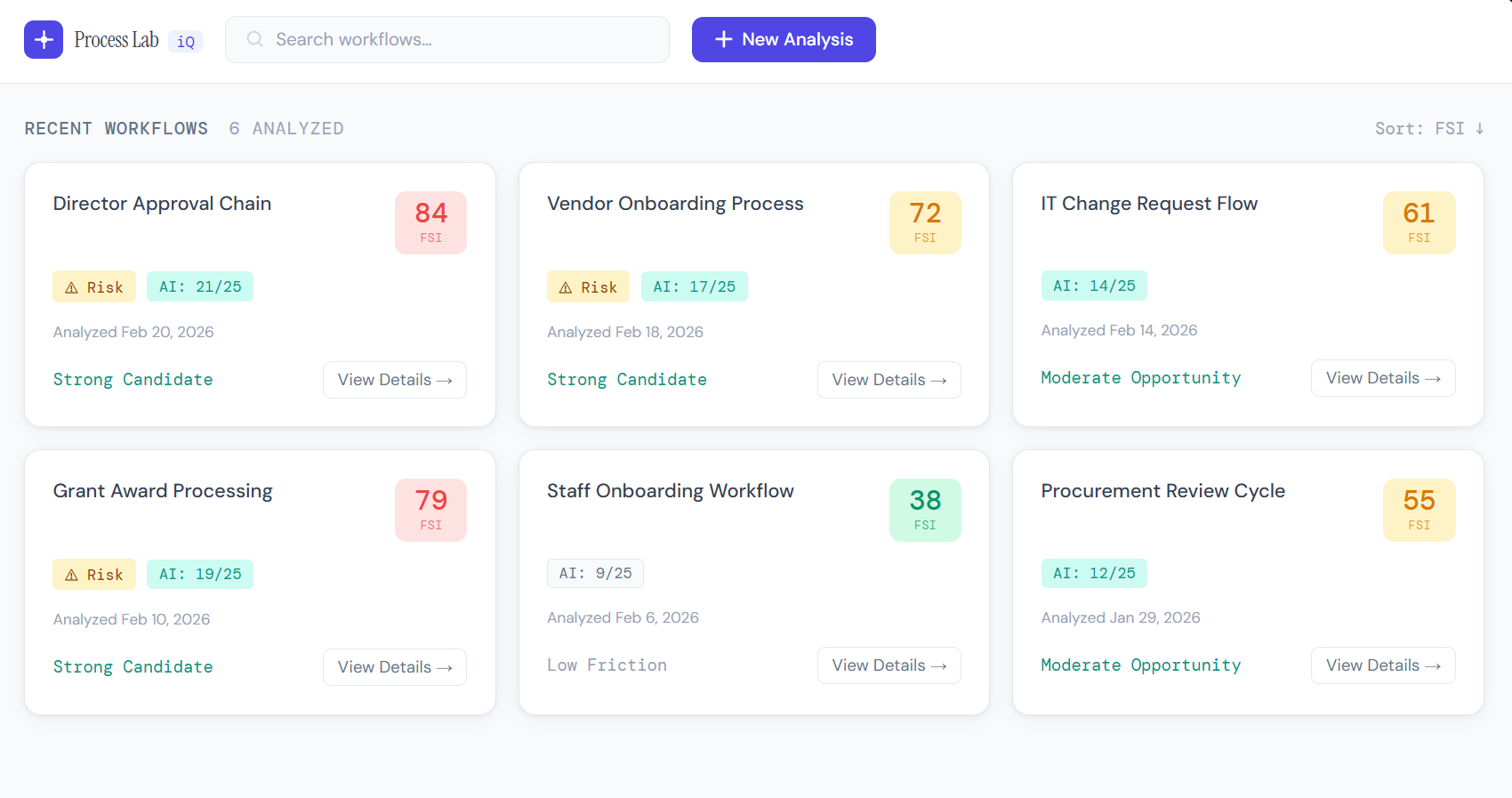
Process Lab main home page.
CHALLENGE
Five-Stage Diagnostic Pipeline
Process Lab operates as a structured pipeline. Each stage builds on the previous one, moving from raw process description to actionable, testable experiments. The system outputs a reconstructed workflow map, a friction map with tagged constraints, quantified scoring, an AI Opportunity Index, three micro-experiments with deployment plans, and an executive-ready summary.
2
Friction Classification
Tag each step with friction type and severity
HOW IT WORKS
1
Workflow Reconstruction
Rebuild the process from user input into a structured map
3
Constraint Identification
Locate the primary bottleneck limiting throughput
4
AI Opportunity Mapping
Evaluate where AI patterns apply structurally
5
Experiment Design
Generate testable, reversible micro-interventions
One Tool, Three Experiences
The Customer Service Portal needed to serve three fundamentally different user groups, each with distinct needs. Global customers needed a one-stop shop to submit requests and track their status. Business teams needed a centralized, streamlined tool to manage a series of interconnected workflows. And leadership needed a transparent, analytical tool to manage resources and understand portfolio performance.

Global Users
A single portal to submit requests and track status — replacing fragmented email-based processes with transparency and accountability.
Built to scale from day one
A primary goal of the Customer Service Portal was to minimize the customization of the tool for each subsequent business process. From the very first iteration of the first module, we were building with modularity and scalability in mind. We designed a solution that worked for 80% of the business use cases, standardized the data fields to the extent possible, and created a consistent and unified user experience.
As we scaled the tool, onboarded more teams and processes, and deployed to more customers, we started from an 80% solution and were able to quickly and efficiently scale. Each new module — whether it was design review, permit processing, or maintenance requests — could be stood up rapidly because the underlying architecture, interaction patterns, and data model were already proven.

AI Review Assistant for Verifiers
The AI review assistant pre-screens submissions against bureau standards, flags potential compliance issues, checks for completeness across required fields, and surfaces similar approved requests as reference — reducing initial review time while keeping human expertise at the center of every decision.
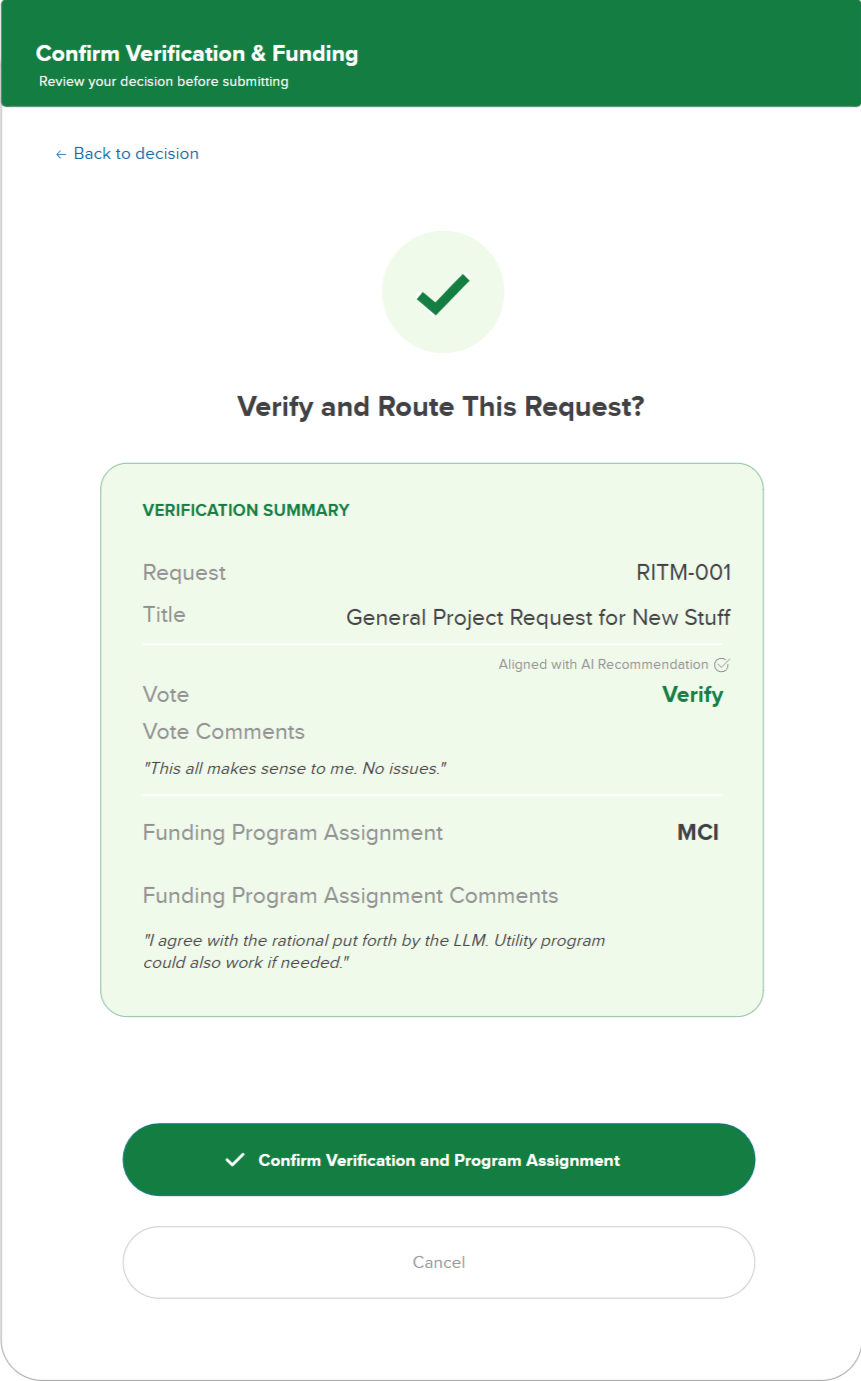
Verifiers receive an AI-generated review summary alongside each submission, highlighting what looks good, what needs attention, and what may require closer examination. They can accept, override, or dismiss any AI suggestion — the tool assists, it never decides.
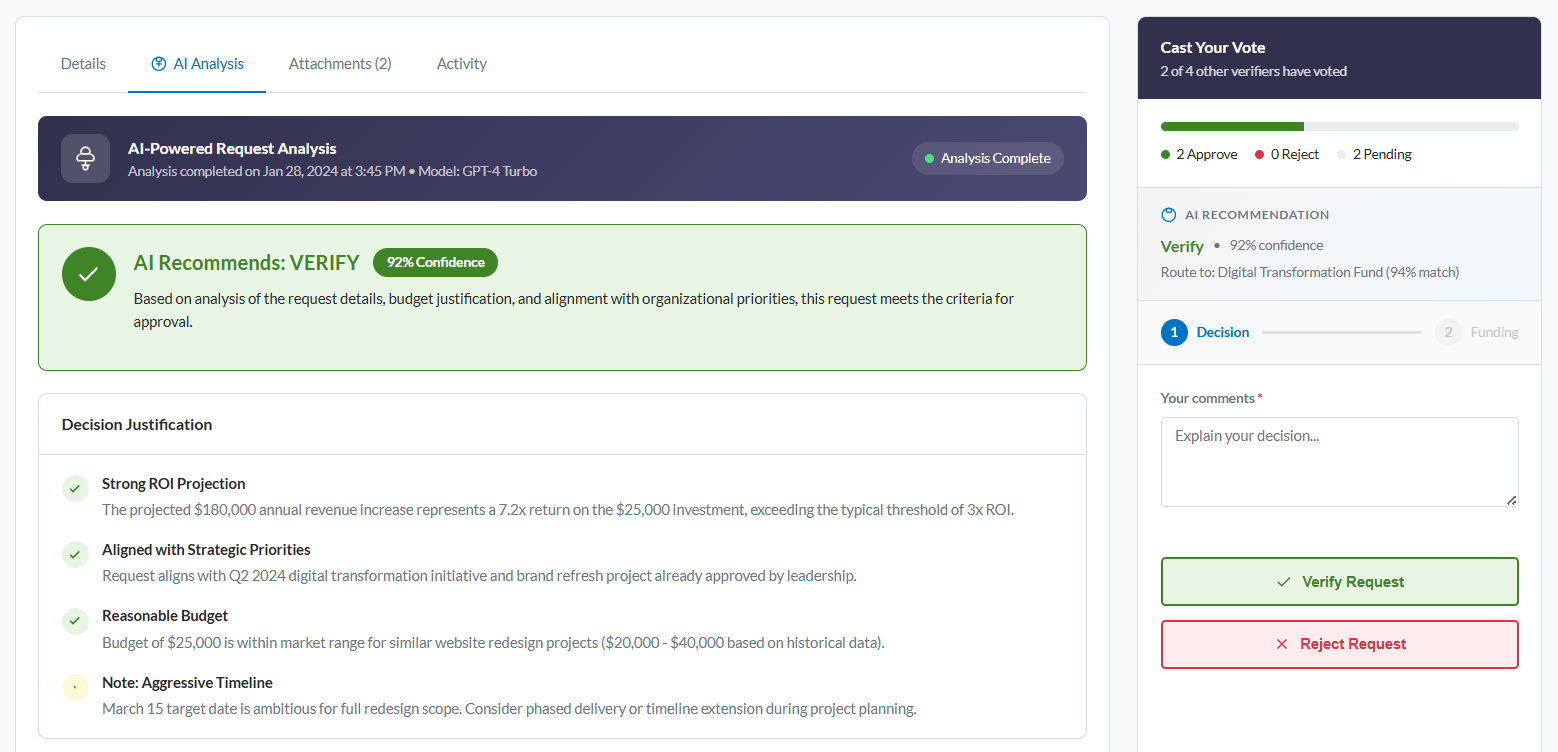
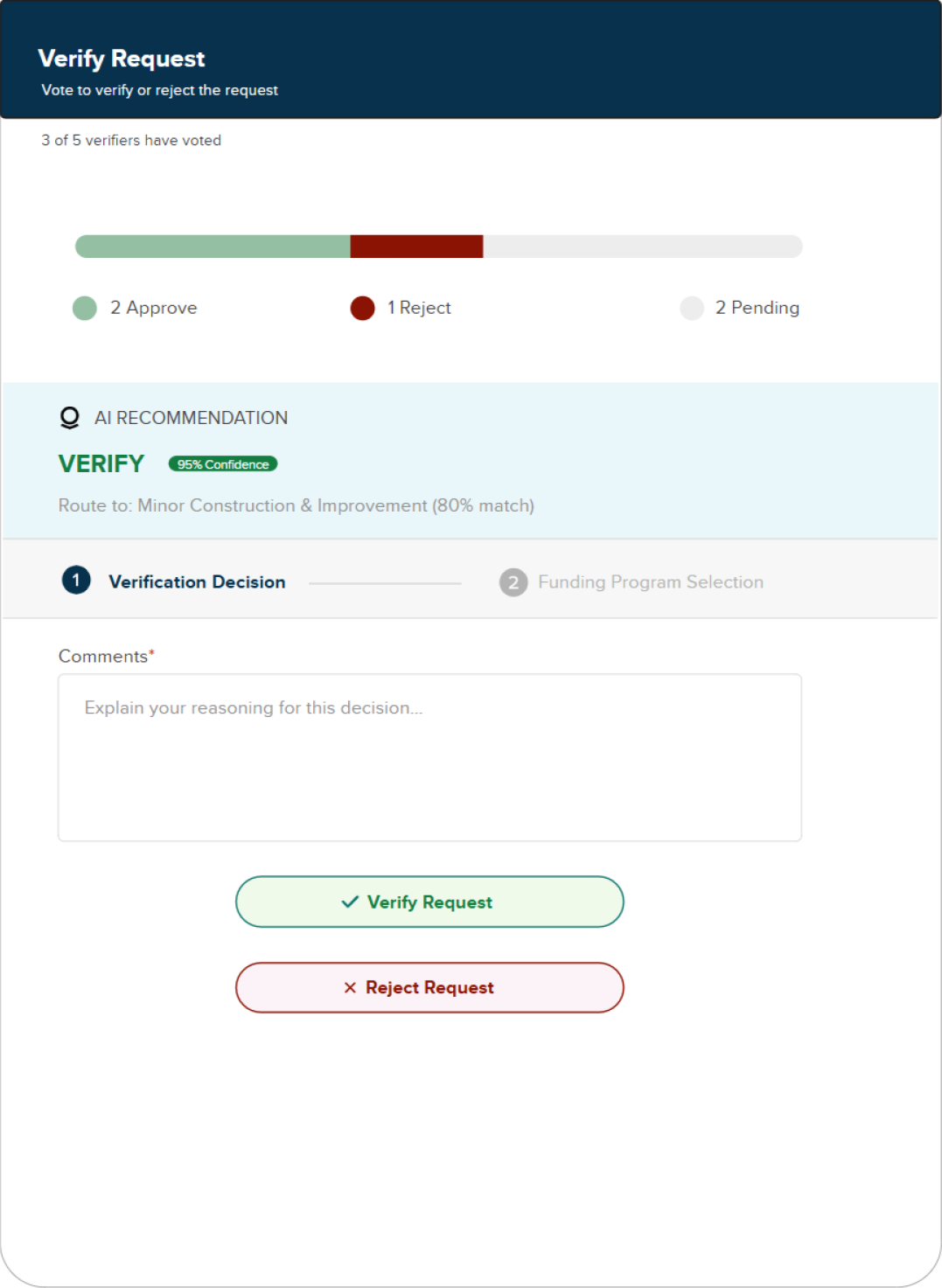
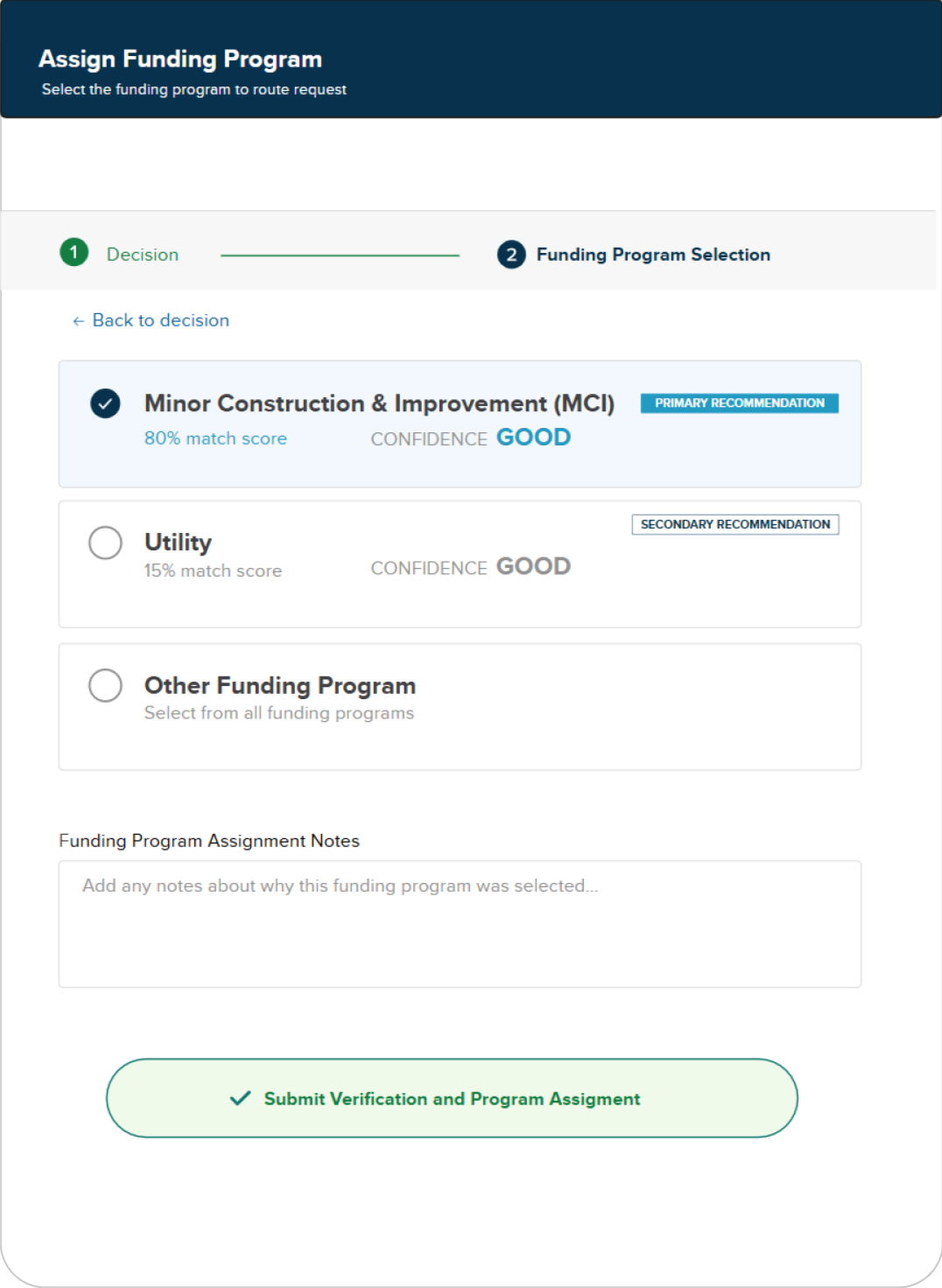
Verifier screens displaying AI recommendations
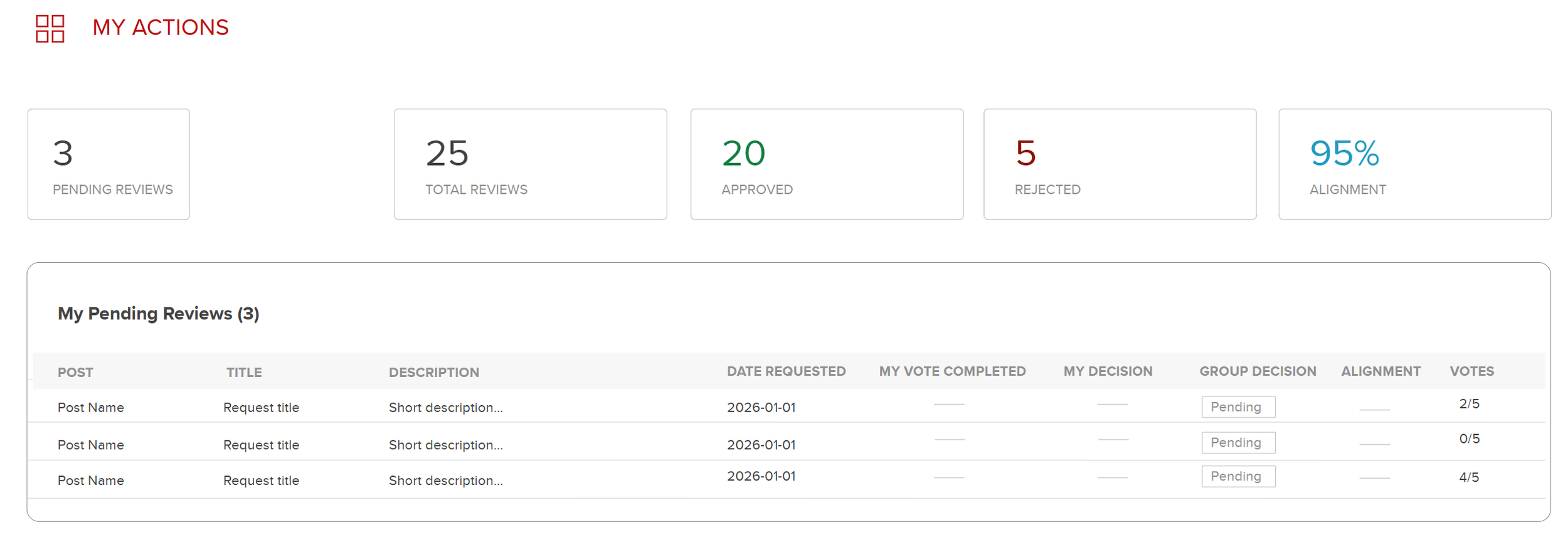
Verifier task list
SOLUTION

Business Teams
Centralized workflow management with standardized handoffs, automated routing, and a consistent process across all business modules.

Leadership
Portfolio-level analytics with real-time dashboards, resource visibility, and the ability to drill down from aggregate metrics to individual requests
Adding Intelligence to the Review Process
As the portal matured and adoption grew, one of the most time-consuming bottlenecks became clear: the verification and review stage. Reviewers across disciplines — structural engineering, architecture, interior design — were spending significant time manually checking submissions for completeness, compliance with standards, and consistency across documents. The process was thorough but slow, and the Bureau's growing volume of requests was straining reviewer capacity.
To address this, I led the design of an AI-assisted review feature that provides intelligent support to verifiers without replacing their judgment. The system pre-screens incoming submissions against established criteria, flags potential issues and inconsistencies, and surfaces relevant precedents from previously approved requests — giving reviewers a head start so they can focus their expertise on the decisions that truly require human assessment.
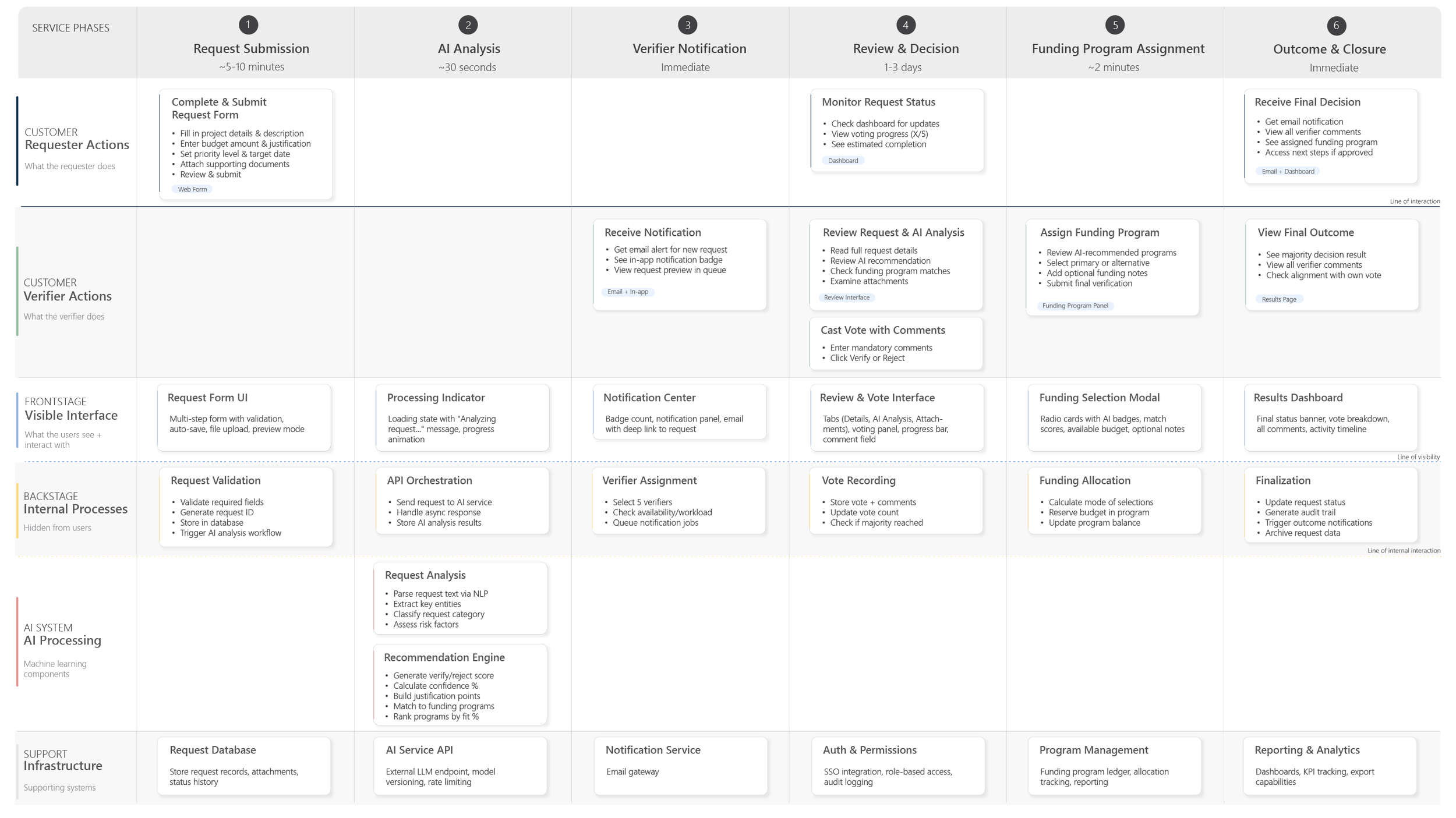
Service blueprint showing process with important front and backstage touchpoints.
A transformative shift
The Customer Service Portal was a transformative way of working for the Bureau and was in part the impetus for a much larger digital transformation effort. Customers who once dreaded their tasks commented on the efficiency and transparency being a breath of fresh air. Business users benefitted from the centralized and standardized way of tracking and managing their workflows. And for the first time, senior leadership had portfolio-level insight into the work and resources.
IMPACT